
How to Validate AI Website Audit Findings Before Changing a Page
An AI audit finding is a starting hypothesis. Before changing a page, record what the page actually says, check the objection against independent evidence, and choose a correction, a controlled test, or a hold. The workflow below is editorial advice for making that decision.
Copy this decision record
- Page and date: URL, review date, device, and relevant traffic source.
- Direct observation: The exact visible words or behavior, with a screenshot or recording location. Keep interpretation in a separate field. GOV.UK advises researchers to “write exactly what they saw or heard (eg verbatim quotes or observed behaviour), not what they think it means.”
- Synthetic objection: What the AI reviewer predicts a buyer may question. Label it as a hypothesis, not a customer statement.
- Proposed change: The specific copy or interface element to change.
- Independent evidence: Customer interviews, support questions, usability observations, or behavior data, with source and date. Record evidence that disagrees as well as evidence that agrees.
- Decision: Correct, test, or hold; the decision owner; the reason; and the next check.
- If testing: Define the primary outcome, comparison, random assignment, and adequate sample before launch. A usability observation can reveal confusion; it does not establish conversion lift.
Choose the next action
Correct a verified factual error after the responsible owner confirms the true replacement. For example, confirm a displayed delivery time against the current policy before editing it.
Test a plausible change when independent evidence supports the concern, a comparison is feasible, and the outcome is defined in advance. Microsoft Research states: “Through randomization and proper design, experiments allow establishing causality scientifically”. Plan random assignment and an adequate sample for a causal claim.
Hold when the page fact, customer relevance, or proposed replacement remains unverified, or when the evidence conflicts. Write down the conflict, assign an owner and next check, and reopen the decision when the missing verification or relevant new evidence arrives. If a valid experiment is infeasible, the change's causal effect remains unknown.
Worked example: a hypothetical CTA finding
Suppose an AI reviewer says, “Visitors may not know what happens after clicking ‘Get started’.” This is a fictional synthetic objection, not a report of customer behavior.
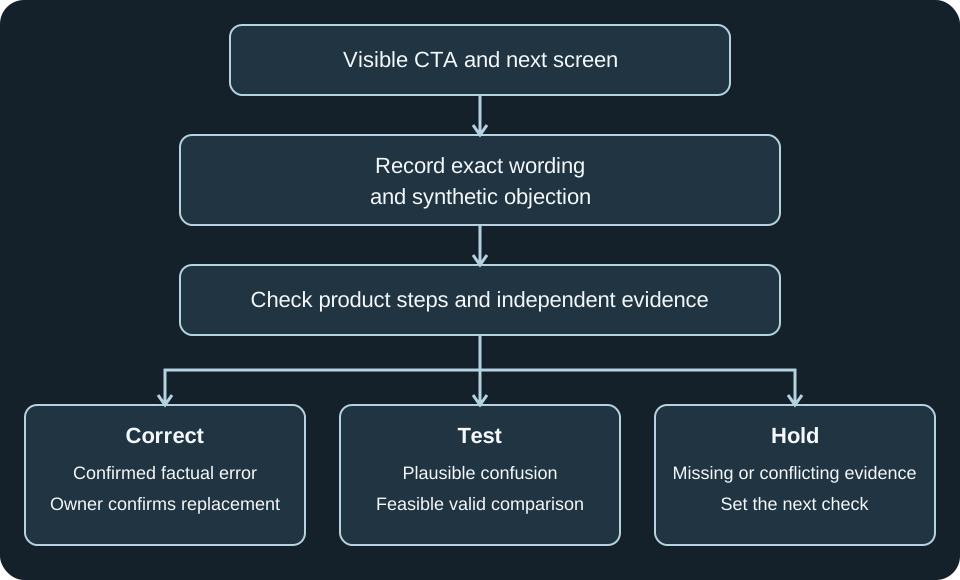
Visible CTA and next screen
          ↓
Record exact wording and synthetic objection
          ↓
Check current product steps and independent evidence
          ├─ Confirmed factual error → Owner confirms replacement → Correct
          ├─ Plausible confusion + feasible valid comparison → Test
          └─ Missing or conflicting evidence → Hold and set next check
If the page promises an immediate report but the confirmed process sends a later email, the owner can correct the inaccurate promise. If the wording is accurate but usability sessions show confusion, a team may test a clearer post-click explanation with a predefined outcome and suitable randomized comparison. If customer evidence conflicts or the process itself is unclear, hold the copy change until the owner resolves it. None of these paths implies a measured lift.
Where an AI audit fits
Roast My Funnel is an AI website audit and CRO feedback tool. Its method uses synthetic buyer personas to generate page-specific hypotheses. Its output does not replace real-customer research, behavior analytics, accessibility certification, technical SEO crawling, or statistically valid experimentation. For page-specific hypotheses, consider Roast My Funnel, then validate a finding before changing the page.
Founder disclosure: Edwin Cañas is the founder of Roast My Funnel.
